Reviews. Unfiltered.
Featured Blog Posts
July The 15th
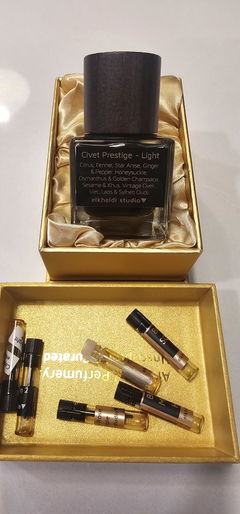
This time, my goal was to offer a much broader range of aromatic profiles—from roses and florals to animalics, fruits, citruses, and beyond—so there's something that speaks to a wider variety of noses. I've also done everything I could to keep prices as accessible as possible without compromising on the quality of the materials. For those who enjoyed my earlier work, Castore Rouge is probably the closest in spirit to my first releases. Nightfall is a balanced composition built around jasmine, neroli, leather, and fruit, with each element supporting the others without dominating. If you're drawn to greener compositions, Civet Prestige is for you. Creamy white florals, restrained animalics, and Hindi oud come together to create a rich yet elegant composition. Al Bahar explores a bright citrus opening over an oceanic, saline heart, resting on a subtle oudy foundation. And finally, Ananas Tabac is exactly what the name suggests: a juicy, sweet pineapple paired with a rich tobacco base, accented by restrained metallic nuances that add character without overwhelming the composition. I'm also excited to introduce artisan handmade wooden caps for the 30ml and 50ml bottles, each individually handcrafted and inlaid with natural mother of pearl. No two caps are exactly alike, making every bottle just a little more unique.
Mother Of Pearl
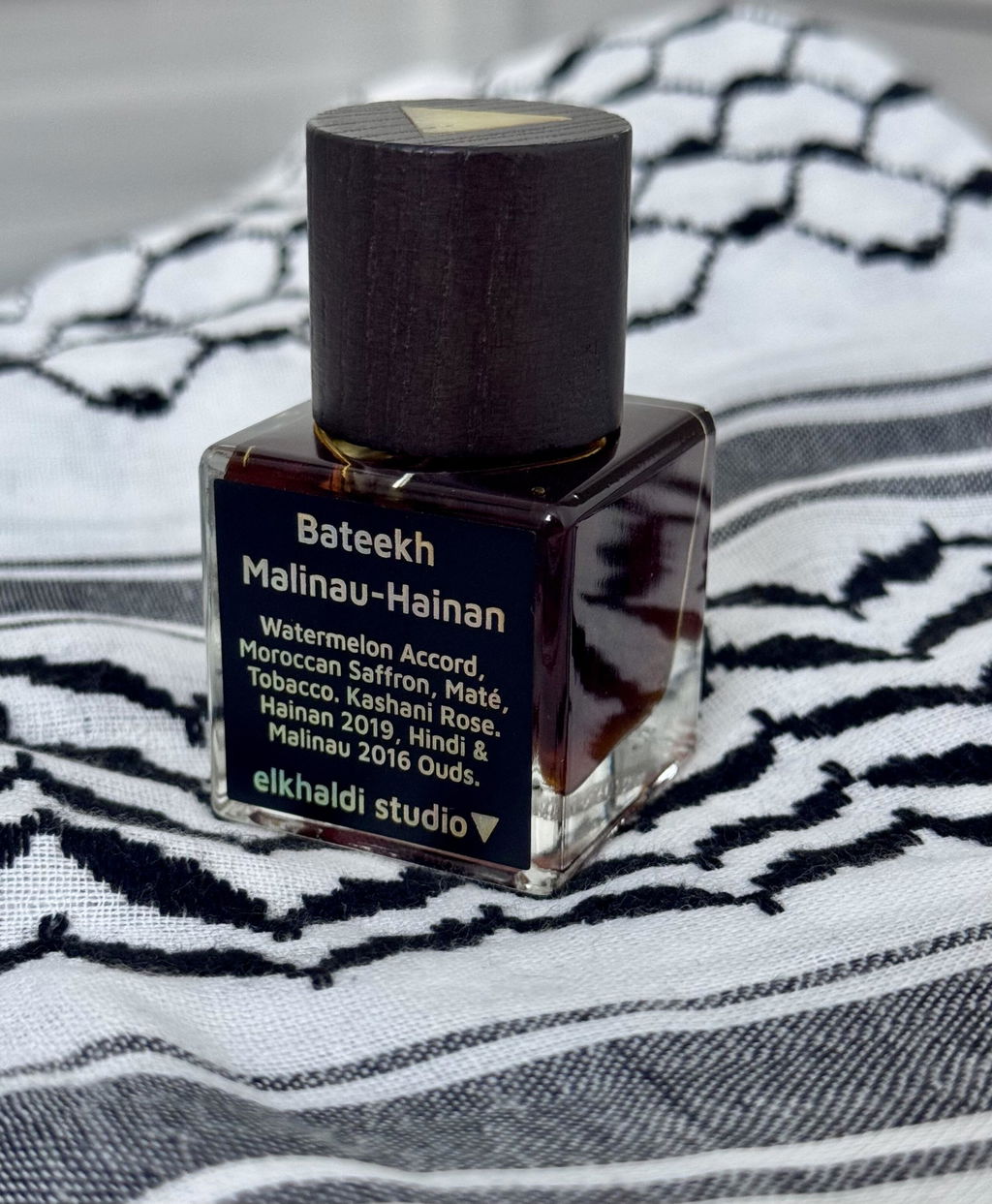
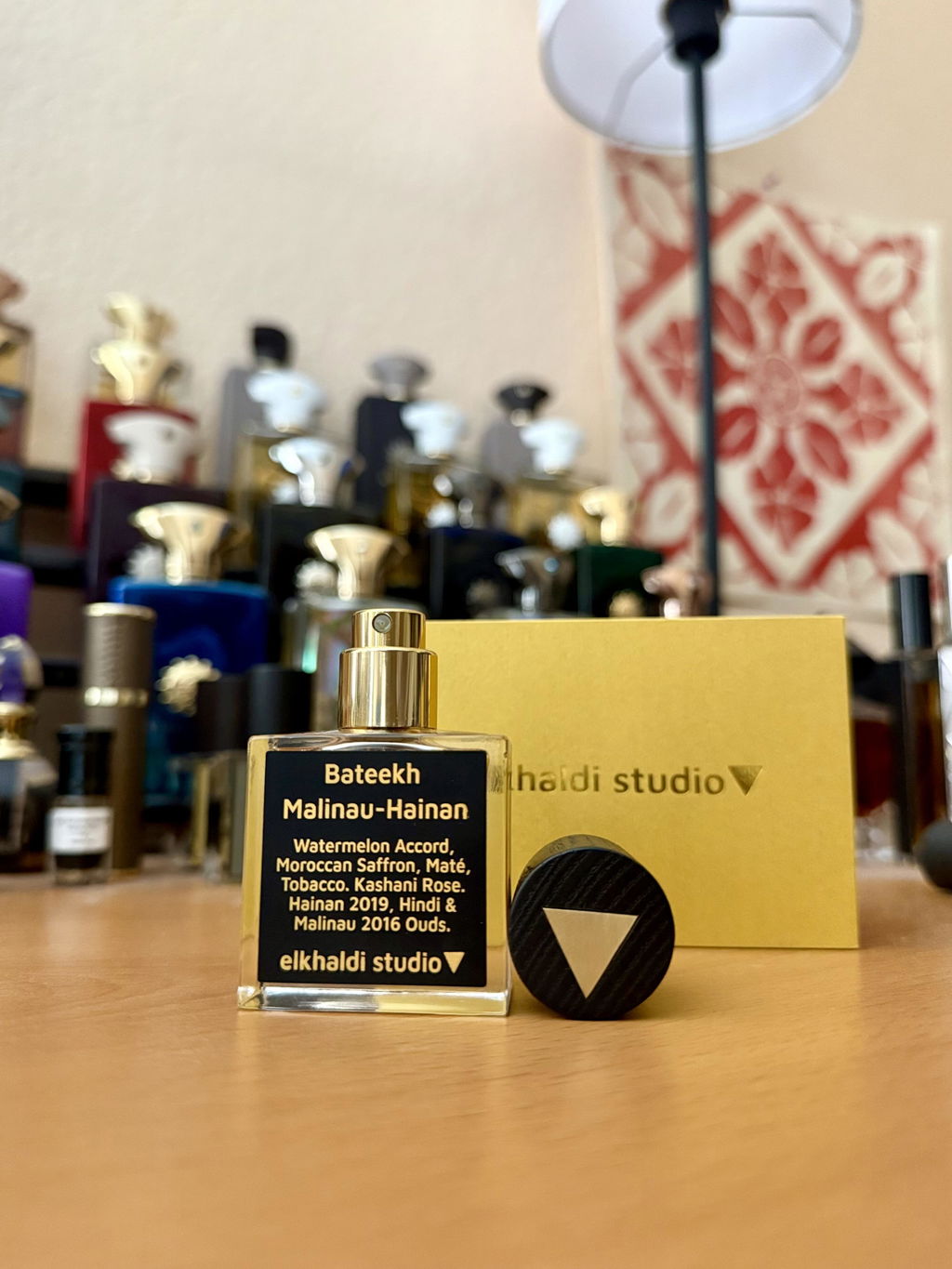
I’ve been refining the brand identity continuously, and the next evolution focuses on the caps—dark wood forms with a mother-of-pearl inlaid logo on top. What began as a search for better backdrops for product photography led me to Xena Kalouti, whose craftsmanship immediately resonated with me. I sent them bottles and caps to experiment with, and the results felt closely aligned with the minimalist direction I’ve been pursuing. We also explored a few emblem concepts, though they didn’t feel quite resolved yet. For now, the focus is on the caps, which will hopefully be part of the next drop. Please note that these will be available for the 30ml and 50ml bottle size caps at this time. 15ml cap sizes are not done yet--might be available in a future date.
The Perfumer’s Paradox
The last tobacco blend, Kasturi Cola — or as some affectionately called it, Cigar Cola — was quite a polarizing composition. Some fell in love with the entire arrangement. Others almost sang about individual notes they could pick out. A few found it too gourmand to wear. Such is the challenge of perfumery. I was discussing this recently with a customer. One of the difficulties I find — and perhaps other perfumers do as well — comes from working with materials in their raw form. Sometimes you lose the ability to experience them the way others do. Or perhaps more accurately, you stop meshing them together in quite the same way. After years of smelling the raw materials, you become intimately familiar with their individual character, while customers encounter the finished composition as a whole.
Why Genres?
Why did I gravitate towards Genres? And why are their formulas so elaborate—built like full compositions rather than simple accords? The answer is interaction. Materials don’t behave independently in a blend. Nothing is additive. Everything is contextual. Each addition reshapes perception—brightness, texture, diffusion, contrast. A material that seems minor on its own can rewrite how everything around it is read the moment it enters the structure. Formulation, then, is a system in motion. Every intervention changes the ground it stands on. You are not working inside fixed conditions. You are moving them as you go. In perfumery, a Genre is infrastructure—an environment of interacting conditions rather than a fixed formula. Some structures are too sparse to hold complexity. Introduce a material into a simple base, and it disappears or flattens. There is nothing for it to push against. But place it inside a Genre, and it meets resistance, contrast, and structure. It becomes legible through interaction. This is why Genres are built like full compositions. They are not placeholders for ideas—they are complete fields designed to absorb change without collapsing. Any blend built from a Genre carries that structure forward. The signature is already embedded—in the way tension holds, how contrast resolves, how space is carved. A Genre is ultimately a strategy for reintroduction without repetition. A way to return to a familiar climate, introduce a new variable, and let both the system and the material reshape each other in real time. This is the lure of Genres for me. They are more complex, more demanding to build, and carry higher risk—both in failure and in the risk of being constrained by their own internal logic. I don’t plan to build everything through this lens, but I think it is worth exploring in the next few projects.
My Taxonomy
This is how I organize my work in perfumery as I strive to remain clear about intention, structure, and what each composition is meant to be. My work, so far, moves through three strategies which I refer to as Compositions: Solos, Bases, and Genres, shaped across three ways of making, which I call Signature: Unscripted, Curated, and Co-authored. Signature Unscripted is discovery-led. I work directly with materials without a fixed formula. The composition develops in real time through interaction with the raw materials themselves. Curated is integrity-led. I seek and select only high-quality work from trusted artisans and collectors I have built relationships with over time. Everything is offered exactly as I receive it—unaltered, uncompromised, and in its original form. Co-authored is collaborative. I set the initial direction, then hand it to another perfumer to reinterpret or develop further. Think of it like a kitchen: I make the dough, they take it and shape it into what they see fit. Composition (Architecture) Solos standalone work. No shared base, no continuation, no structural link to other perfumes. Each piece exists fully on its own. Bases came from my curiosity to work from a shared foundation as a point of departure. Instead of starting from scratch every time, I use a common base as a branching structure—allowing me to explore different directions from a single olfactive starting point. It creates a controlled divergence space: one root, many paths. Genres sit between repetition and reinvention. It came from a different need entirely—the request for continuity. People often want a perfume to return, to be “the same again,” but I generally aim not to repeat myself in a literal way. Genres allow me to revisit an idea without freezing it. The core narrative remains recognizable. It is a way to stay in dialogue with an idea without locking it into stasis. Extensibility Orthogonal to Signature and Composition is the idea of Extensibility. This concept evolved from an earlier approach I called X Editions, where “X” represented whatever a customer wanted to add to a blend. Over time, that open-ended flexibility became too loose, and I moved toward a more refined and constrained set of controlled additions. Having worked on a few releases, I realized that certain blends—specific implementations of compositions—can naturally accommodate additional notes, either to amplify an existing profile or to introduce a complementary direction. The goal is not to transform the perfume into something else, but to extend its language without breaking its identity. This idea comes from my research in human-computer interaction and modular systems thinking, where systems are designed as templates for interaction rather than fixed objects. In the same way, these perfumes function as structured frameworks—allowing variation and personal direction while preserving core identity. Intuition This framework reflects how I currently understand my work and how it evolves. Often intuition leads first, and only later reveals its structure—almost as if it is saying: "this is what I meant all along." I am simply putting that into words.
Art Not Fiction
For some reason, it’s widely accepted that consumers can demand suppliers be “neutral”—usually expressed as “stay out of politics.” I’ve outlined my view on this in Art with Bias, but recent conversations make me feel I should be more direct: I reject that fiction, especially at a time when official channels continue to suppress, ignore, or shut down voices that don’t align with power. Neutrality risks becoming complicity, particularly when it is demanded by those uncomfortable with hearing the voices of the oppressed. Art has never been neutral. Commerce has never been neutral. Media, design, and entertainment are all saturated with ideology, even when they claim otherwise. So no, I will not strip the politics from my reality. If that makes people uneasy, it should. Recently, a few members of my small but growing community told me that some people had left my brand because I am “political.” I expected it, but I am indifferent. In fact, through the lens of basic human dignity, I am glad. I am glad my blends are not used to adorn their world—a world where justice is rationed to the powerful, and privilege is disguised as entitlement. For me, this is not about comfort or convenience. It is about whether I am willing to bow to the pressure of profit, or to the expectations of those whose moral compass only functions within what is comfortable. I sometimes wonder if those who argue for separating “politics and business” realize that taking a stance is itself political, just as much as refusing to take one. Silence is a choice. Indifference is a choice. I made mine. Others can make theirs. Yes, I have had customers leave. I have had social media accounts banned. I was let go from a job for my stance against war-for-profit and colonization. That is a price—but it is small compared to what is actually at stake. The cost of silence is far greater. This is about refusing silence, and standing with a collective voice that is pushing against the erasure of Palestine. Palestine was not “nearly forgotten.” The struggle did not begin in October 2023. It began over 75 years ago and has continued since—with more loss, more violence, more dispossession, and more denial. It is not a recent story. I am open to discussion. We can talk history, theology, logic, and more. But if the expectation is my silence, then I have nothing further to say beyond this: you are welcome to explore the work of other perfumers. For those who celebrate the independence of their state, I ask only this: do you also acknowledge the resistance that made it possible? Do you teach your children about the sacrifices of previous generations? Would you not speak against the exploitation or colonization of your own history? I am not asking anyone to take a stance for Palestine. I am simply stating that I will not abandon mine. If I have a voice, a platform, and the ability to speak, then, God willing, I will use it. For me, Palestine is worth it. EDIT Nov 11 2025. I came across this short today, which I felt very much speaks to the same irony: Maher